How the intake-to-signal handoff quietly determines whether your pharmacovigilance system is actually compliant, or just documented.
Most organizations treat Medical Information and Pharmacovigilance as two separate functions. Different teams, different systems, different reporting lines, different KPIs. Medical Information exists to answer product questions from healthcare professionals and patients. Pharmacovigilance exists to process adverse event reports. On an org chart, that division makes sense.
In practice, it is a structural gap that signals fall through every day, and most organizations only discover it when an inspector finds it first.
The separation is not an accident. Medical Information is built around response time and call resolution. Pharmacovigilance is built around case processing and regulatory timelines. Different skill sets, different training, different vendors in many cases. Keeping them apart looks like good functional design, and for most of what each team does day to day, it is.
The problem is not the org chart. The problem is what happens at the seam between the two functions, where a routine product inquiry can also be a reportable safety event, and where nothing in most companies' workflow guarantees that overlap gets caught.
Under ICH E2D and GVP Module VI, a valid adverse event report requires only four elements, and nothing in that standard says the report has to arrive through a channel labeled “safety.” A caller asking about dosing who mentions, almost as an aside, that their mother developed a rash after switching to the generic has just given you a reportable event. Whether that event gets captured depends entirely on whether the person on the phone recognizes it as one, which is why this test needs to live in Medical Information's training, not only in the PV department's SOPs.
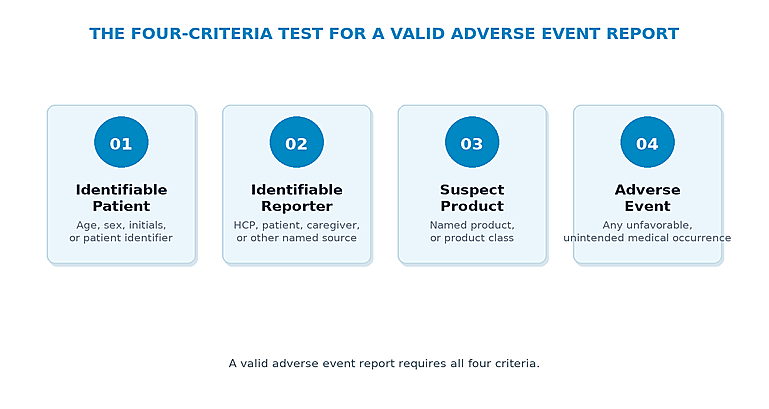
Figure 1. All four elements, from any source, through any channel, make a case reportable within regulatory timelines.
|
The 15-day reporting clock starts from the date of first awareness by any company personnel, not from the date the case reaches the safety database. |
The clock starts before PV ever hears about it. Expedited reporting timelines for serious, unexpected adverse reactions run from the date of first awareness by any company personnel or agent. If a Medical Information associate does not flag a safety-relevant statement in real time, the 15-day clock is already running down before pharmacovigilance knows the case exists. That is not a processing delay. That is a compliance gap, and it is exactly the kind of gap inspectors are trained to find.
Inspectors test this interface specifically. GVP Module VI and equivalent FDA guidance both call out medical information and call center data as a required source for pharmacovigilance systems to monitor. A routine PV inspection will typically sample Medical Information call logs and reconcile them against the ICSR database, check whether MI staff received documented AE-recognition training, and review the SOP that governs the handoff between the two functions. When the two systems were never designed to talk to each other, that reconciliation turns up gaps, and gaps found at inspection cost far more, in remediation time and in regulatory standing, than the same gaps caught internally.
.png)
Figure 2. In a siloed model, days can pass before a case is even recognized, shrinking the window that remains for compliant reporting.
Leading indicators get discarded, not just individual cases. A single missed report is bad. A pattern is worse. If Medical Information starts fielding a cluster of questions about a specific side effect before formal adverse event reports accumulate, that pattern is an early signal in its own right, the kind aggregate reports are supposed to draw on.
When inquiry data sits in a CRM that pharmacovigilance never sees, that signal disappears before anyone has the chance to act on it, and the aggregate report is built on an incomplete picture without anyone realizing it.
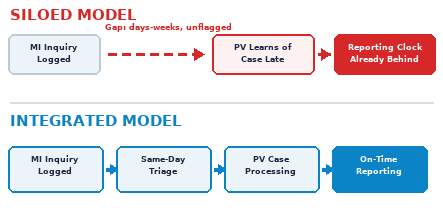
Figure 3. The same inquiry, handled through two different operating models.
|
Dimension |
Siloed Model |
Integrated Model |
|
Training |
MI staff trained on product content only |
MI staff trained on the four-criteria AE test as standard practice |
|
Systems |
Separate CRM and safety database, no shared intake |
Shared intake or a defined same-day handoff between systems |
|
KPIs |
Call resolution time only |
Call resolution time plus adverse event capture rate |
|
Reconciliation |
None, or only at inspection |
Scheduled internal reconciliation between MI logs and ICSR database |
|
Inspection outcome |
Gaps surfaced by the inspector |
Gaps identified and closed before the inspector arrives |
Fixing this is not about merging the two teams into one. It is about building the connective link between them, deliberately, rather than leaving it to chance.
Train every Medical Information associate on the four-criteria AE test, not as a one-time compliance module but as a standing part of how they listen to every call.
Route intake and triage through a shared system, or at minimum a defined same-day handoff with a hard service level, not an end-of-week batch process.
Add adverse event capture rate to Medical Information's KPIs alongside call resolution time, so speed is never rewarded at the expense of a missed signal.
Reconcile Medical Information logs against the ICSR database on a fixed internal schedule, well before an inspector does it for you.
Feed Medical Information inquiry trends into signal detection and aggregate reporting, so a cluster of questions can be treated as an early indicator, not just noise in a call center CRM.
None of this requires collapsing two functions that are genuinely different in skill and purpose. It requires treating the boundary between them as a designed handoff instead of an accidental gap.
Use this as a quick internal gut check. If you cannot answer confidently, that is where the gap most likely lives.
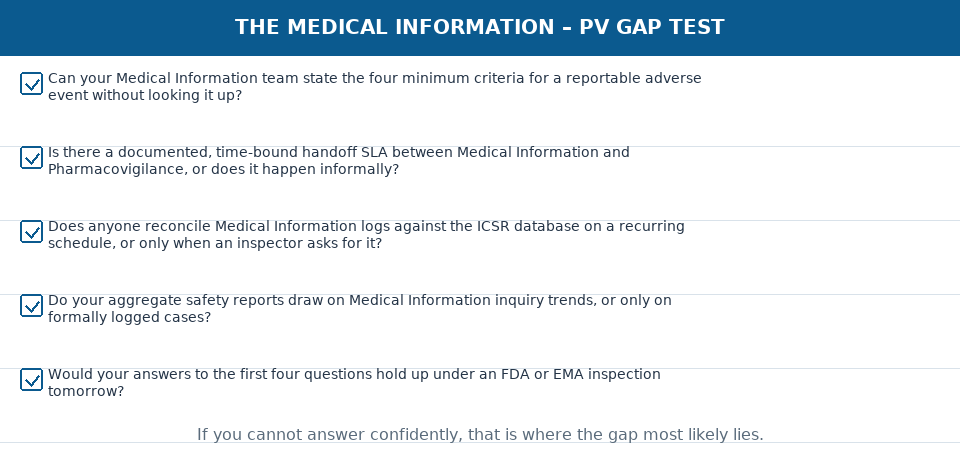
Organizations that keep Medical Information and Pharmacovigilance fully separate are not avoiding risk by keeping the functions clean. They are choosing not to see part of their own safety data until an inspector points it out for them, at which point the cost is no longer a training gap, it is a finding, a remediation plan, and a mark on the inspection record.
At AWINSA Life Sciences, we build integrated Medical Information and Pharmacovigilance workflows, covering intake, triage, case processing, signal detection, and aggregate reporting. Request a complimentary Medical Information-PV gap review and we'll walk your current handoff against the five questions above.
Copyright © 2024 AWINSA Life Sciences Pvt. Ltd. All rights reserved.


59 E,Shrewsbury Place
Princeton, NJ 08540
United States

E13/9 First floor, Vasant Vihar,
New Delhi 110057

Wilhelmina Druckerlaan 10,
6532 SR,
Nijmegen,
The Netherlands

Cerrada Ahuizotla 53,
Col. Santiago Ahuizotla,
Del. Azcapotzalco
CP.02750
Ciudad de México, México.